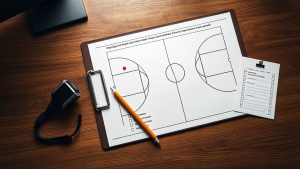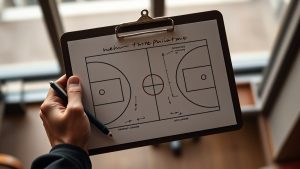
Your big can handle in transition, hit cutters from the elbow, and knock down the occasional three. And yet the offense stalls. Possessions end with him posting up against a set defense while four teammates stand and watch, or he drifts to the perimeter and the ball never comes back. The talent is there; the structure isn’t. Learning how to build an offense around a positionless center starts with accepting that no single play fixes this.
What fixes it is a system: an honest read of what he does best, spacing that gives those skills room, and two or three actions he can run and read before adding counters for how defenses respond. This guide gives you a five-step design process — audit his skills, choose your spacing, design the actions, layer in counters, and set practice priorities — so the offense flows through him instead of waiting on him.
How to Build an Offense Around a Positionless Center
Before you draw a single action, audit your big honestly. Every decision downstream depends on this, so resist the urge to skip ahead. The question isn’t whether he’s talented. It’s what he can actually do when a defender crowds him and the shot clock drops under eight.
Audit Three Skill Buckets
Start with handle under pressure. Can he dribble through a trap, or does he need a retreat dribble and an outlet? Watch him against contact, not air. Then grade passing vision and delivery: does he see the weak-side cutter early, and can he make the skip pass over a rotating defense? Finally, shooting range and release speed. A slow release changes your spacing more than a short range does.
Record Where He Catches, Where He Wants the Ball, and Which Hand He Drives With
Chart his catches across a scrimmage. Note the elbow, the short roll, the wing, the dunker spot. Then ask where he actually wants the ball, because comfort drives decision speed. Log his dominant drive hand too; it tells you which side of the floor to load with shooters.
Decide His Primary Role
Pick one: hub at the elbow, screener who pops, or short-roll playmaker. A hub runs handoffs and reads cutters. A popper spaces and shoots off the catch. A short-roll playmaker catches on the move and finds corners. You can add a second role later, but the first one sets your base.
Set the Build Order
Now commit to sequence: spacing before actions, actions before counters, counters before live practice. This is how to build an offense around a positionless center without chaos. Skip the order and players learn plays they can’t space, then blame the big when the floor cramps.
Choose Spacing That Gives Your Center Room to Operate
Spacing is the decision that makes or breaks the rest of the system. Before you install a single action, decide where the other four players stand, because that choice determines which passing lanes exist and how far help defenders must travel. Get it right and your center’s skills breathe. Get it wrong and every dribble handoff runs into a crowd.
Five-Out Spacing
Five-out puts all four teammates beyond the arc, emptying the paint completely. This maximizes driving lanes and gives your center clean kick-out passing angles when the defense collapses. The cost is real: it demands four other shooters, or defenders will simply ignore the non-shooters and clog the space you created.
Four-Out With a Dunker Spot
Four-out keeps one player in the dunker spot along the baseline while three spot up around the arc. You sacrifice a little driving room but gain a constant rim threat and simpler reads, which suits younger or less experienced rosters. Your center still handles at the top with a genuine passing target nearby.
Horns Alignments
Horns places two bigs at the elbows, creating a clean handoff hub for a center who passes. It’s the easiest alignment for getting the ball into his hands at the top of the key with symmetry on both sides. From there, he can hand off either direction and read the defense.
Widen the Corners and Keep the Weak-Side Wing High
Whatever alignment you choose, stretch the corners toward the sideline and keep the weak-side wing high above the arc. Help defenders then must travel farther to contest, buying your center half a second more to read the floor. Those small distances decide whether a pass is open or not.
Design Actions That Put the Ball in His Hands
Once the spacing is set, you need actions that give him the ball in motion rather than standing still. Build in this order, and don’t skip ahead until the first action is clean.
Start With a Dribble Handoff Series
A dribble handoff is the natural entry point because it combines all three of his skills in one action. He handles the ball toward a teammate, threatens to keep it, and can pass or shoot off the exchange. Run it from the slot and the wing so defenders can’t load up on one side.
Add Delay Action Above the Arc
Delay sets put him in receipt of the ball above the arc, facing the floor with cutters and shooters moving around him. He becomes a passer first. From there he can hand off, hit a backdoor cutter, or step into a shot if his defender sags.
Use Short Rolls After Ball Screens
Instead of a deep roll to the rim, have him short-roll to the free-throw line area. He catches on the move with a live dribble, which lets him find the corner shooter or attack the closeout. It keeps the ball in his hands in space.
Five Steps to Install Each Action
- Pick the entry action that fits his strongest skill.
- Set the spacing around it before you add anything else.
- Define his first read clearly.
- Define the second read for when the first is taken away.
- Rehearse both at half speed until they’re automatic.
Add Counters for How Defenses Will Guard Him
No defense will let your center play the way you drew it up. Build one counter for each coverage you expect, rehearse them until the read is automatic, and the system survives contact with a real opponent.
Beat a Sagging Defender With Fake Handoffs and Slips
When his man drops under the action, the shot is open but the pass is slow. Use a fake handoff to freeze the defender, then slip the screen and hit him rolling into space. The drop gives you the pocket pass every time.
Attack the Switch With a Short Roll or Quick Seal
When they switch a guard onto him, don’t force the mismatch in isolation. Short-roll him into the gap, or seal the smaller defender early and take the entry pass before help arrives. Two dribbles, one decision.
Escape Traps With a Pre-Planned Release
Traps arrive fast, so decide the exit before the game. Drill the release pass to the short corner and the cut behind the trap so a teammate is always available. He passes out of pressure instead of dribbling through it.
Counter Denial With Back Screens and Reverse Entries
If they deny the catch, don’t fight for the same spot. Run a back screen to free him, or reverse the ball and let him catch on the move. Catching in motion beats catching against a chest.
Practice each counter in a live, contested drill with a defender instructed to give that exact coverage. Rotate coverages every few possessions so he learns to read, not memorize.
Practice Priorities and How to Check It Worked
Drill the first read before the counter
Sequence matters in practice. Rehearse the primary read until it is automatic — the handoff into a rim run, the short roll into a corner kick — then layer the counter on top. If you teach the counter first, players start guessing instead of reading. Decision speed improves in order, and so does your center’s confidence as the hub.
What to measure in scrimmages
Keep score of three things during live play: touches in the paint, handoff-to-shot conversions, and turnovers from the hub spot. These numbers tell you whether the system is actually functioning. A high paint-touch count with low hub turnovers usually means the spacing and reads are working together.
Common mistakes that stall the system
Three habits quietly kill a positionless-center offense. Overloading him with too many actions per possession slows his reads. Players standing still after the handoff erase the advantage it created. And ignoring weak-side spacing lets one defender guard two. Fix the spacing first — it is usually the cheapest correction.
How to check it worked
Judge success by one simple test: does the offense generate a paint touch or an open catch-and-shoot within the first two actions? If yes, the system is doing its job. If possessions drag past that, revisit your first read before adding anything new.
Frequently Asked Questions
What makes a center positionless?
A positionless center is a big who isn’t defined by where he stands. He can start a possession with the ball, pass out of pressure, and shoot from distance, so he functions as a creator rather than a finisher parked on the block. The label describes his role in the offense, not his height.
How much shooting does the rest of the roster need for a five-out offense?
Enough that defenders won’t ignore them. In a true five-out alignment, every player on the floor should be a willing, credible catch-and-shoot threat from the perimeter, even if the percentage is only average. If two players are non-shooters, four-out spacing usually serves the group better than forcing five-out and clogging the paint.
Can this system work with a center who is a below-average shooter?
Yes, with adjustments. Lean on his handling and passing instead: dribble handoffs, short rolls, and elbow touches still create advantages without a jump shot. Keep one non-shooter’s defender occupied with a screener or cutter, and the system holds together. The design principle stays the same: build around what he does well, not what he lacks.
Building around a positionless center is a design project, not a playbook. Audit his skills, pick spacing that gives him room, install two or three actions, rehearse counters, and measure touches and decisions in scrimmages. When the system is clear, the big stops forcing the game and starts reading it.