Solving a Blocked Drain in Limão: What to Have Ready Before Calling a Desentupidora
Before you dial anyone, get three things ready: the exact address with any access instructions, a clear description of where the water backs up, and permission to enter the affected area. As a support technician who has handled these tickets for years, I can tell you that most delays in Limão come from missing access details, not from the blockage itself. If you are searching for a reliable desentupidora Limão São Paulo SP, having those basics in hand turns a two-hour ordeal into a forty-minute fix.
Limão is a dense neighborhood in the north zone of São Paulo, full of older houses, small commercial kitchens and condominium buildings with shared vertical stacks. That mix means blockages tend to repeat in predictable patterns, and the technician who arrives with the right context can choose the right tool on the first trip.
What a Day of Drain Calls in Limão Actually Looks Like
My morning usually starts with a ticket from a ground-floor apartment where the kitchen sink gurgles when the upstairs neighbor showers. By lunch, it is a restaurant on a busy street with a grease trap that has not been pumped in a year. By evening, it is a condominium garage drain backing up after heavy rain. Each call has the same first step: confirm what is blocked and what is shared.
Mistake 1: Assuming every slow drain needs the same treatment
A slow sink and a backed-up floor drain are not the same problem. Sinks often clog with soap scum and food residue near the trap, while floor drains and toilets usually point to a blockage further down the branch line or in the main stack. When a homeowner tells me “it is just slow,” I ask whether other fixtures in the same bathroom are also slow. If two or more are affected, the blockage is almost certainly downstream and a simple plunger will not solve it.
Shared slowdowns mean a shared pipe. That single question saves an hour of guessing and prevents the classic mistake of pouring chemical drain cleaner into a line that is already full. Chemicals sit against the blockage, heat up the pipe and rarely clear the real obstruction.
Mistake 2: Calling without checking who owns the pipe
In a house, the owner is responsible for the line up to the public connection. In a condominium, the vertical stack and the main branch are usually the building’s responsibility, while the fixture trap belongs to the unit. I have seen neighbors argue for twenty minutes while water kept rising because nobody knew where the responsibility line was. Before the technician arrives, ask the building manager or check the condominium rules. This is exactly the kind of detail a professional desentupidora Limão will ask about on the phone, and having the answer ready avoids a second visit.
Mistake 3: Clearing the visible drain and ignoring the vent
A drain that bubbles, gurgles or smells like sewage after use is often a venting problem, not a blockage. The vent pipe on the roof equalizes pressure; if it is blocked by leaves, a bird nest or a collapsed section, water drains slowly no matter how many times you snake the fixture. I once spent two hours rodding a kitchen line in Limão before checking the vent stack and finding a nest at the top. The correction took ten minutes.
Gurgling after draining is a vent symptom. If the water level in a toilet moves when you run a nearby sink, note that down. It tells the technician the problem is in the shared air path, not the fixture itself.
Mistake 4: Ignoring the grease trap in commercial kitchens
Small restaurants and snack bars in Limão often have a grease trap that is undersized for the volume they produce. When it fills, grease passes into the branch line and hardens. The owner calls for a drain clearing, the line is opened, and three weeks later the same call comes back. The correction is a maintenance schedule: pump the trap before it reaches capacity, and keep a log. Preventive maintenance is cheaper than an emergency call at midnight.
Mistake 5: Assuming hydrojetting is always the answer
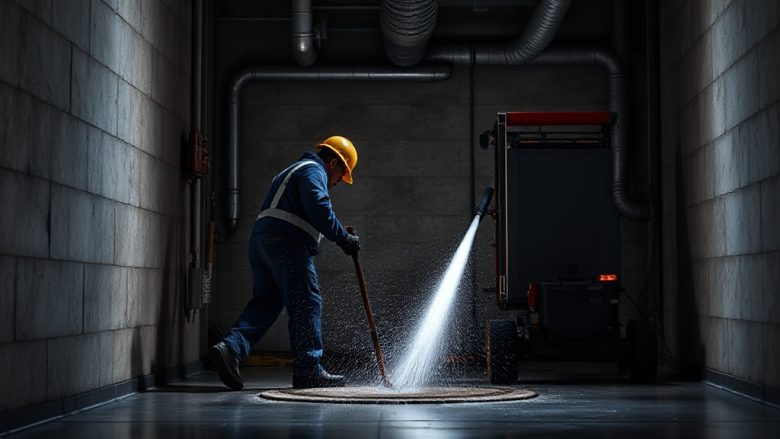
Hydrojetting is excellent for grease, scale and roots in larger pipes, but it is not the first move for every blockage. A camera inspection should confirm the pipe material, diameter and the nature of the obstruction before high-pressure water goes in. Old clay or corroded cast-iron lines can be damaged by an aggressive jet. The right sequence is diagnose, then choose between a snake, a jet or a section repair.
Mistake 6: Skipping the camera inspection on repeat clogs
If the same drain blocks twice in a year, stop treating symptoms. A camera inspection shows whether the pipe has a belly, a crack, root intrusion or a misaligned joint. Without that image, every clearing is temporary. I have seen homeowners spend more on three emergency visits than a single inspection and targeted repair would have cost.
How to Prepare Your Property and What to Expect From the Visit
Clear the area around the affected drain, move cleaning products and stored items away from the access point, and make sure someone over eighteen is present to authorize the work. If the blockage is in a condominium, confirm that the technician is allowed into the garage or service area. These small steps prevent the most common reason a scheduled visit turns into a wasted trip.
When the team arrives, expect a short interview before any equipment comes out. The technician will ask when the problem started, which fixtures are affected, whether chemicals were used and whether the property has had previous blockages. Answer honestly, especially about chemicals, because mixing residues with high-pressure water can create a splash hazard.
What the technician will check first
- Access points: cleanouts, inspection covers and the grease trap lid.
- Water behavior: which fixtures back up and whether the level changes when others are used.
- Vent condition: visible roof stack and any gurgling inside the property.
- Pipe history: previous repairs, material and any known root problems.
After that, the tool choice follows the diagnosis. A hand snake or a small electric auger handles a fixture trap. A larger machine or hydrojetting handles the branch line. A camera confirms the result and documents the pipe condition for the owner or the building manager.
What it costs and what changes the price
Pricing in São Paulo generally depends on access difficulty, the time of day, the pipe diameter and whether the work is a simple clearing or a full hydrojetting job. Emergency calls at night or on weekends carry a premium. A camera inspection is usually quoted separately. Ask for the scope before work begins: what is included, whether the price covers the branch line or only the fixture, and whether a follow-up visit is part of the service.
| Scenario | Typical first approach | What to confirm |
|---|---|---|
| Single slow sink | Trap clearing or small snake | Whether other fixtures are affected |
| Multiple slow fixtures | Branch line snake or jet | Location of the cleanout |
| Repeat blockage | Camera inspection | Pipe material and condition |
| Commercial kitchen | Grease trap service plus line clearing | Maintenance schedule |
If you need a desentupidora em Limão São Paulo SP for an after-hours emergency, say so on the call and describe the water level. Standing water near electrical outlets or in a garage with stored goods is a priority case, and the dispatcher can route the nearest team.
The correction that most properties need
In my experience, the single most effective correction is not a better tool but a maintenance habit. Keep a simple log of every blockage, the date, the fixture and what was found. After two entries, patterns appear: the same line, the same season, the same tenant behavior. That log turns a recurring emergency into a planned service, and it gives the next technician a head start.
The second correction is communication. Tell the neighbors above and below when a shared line is being serviced. In Limão’s older buildings, a single stack serves several units, and a technician working on the ground floor can cause water to back up on the first floor if the occupants keep using fixtures during the job. A five-minute notice prevents an unpleasant surprise.
Finally, keep the cleanout accessible. I cannot count the number of visits where the inspection cover was buried under a shelf, tiled over or painted shut. An accessible cleanout is the difference between a quick clearing and an hour of careful demolition. If you are renovating, mark the cleanout and leave a removable panel.
Put together, the day-in-the-life view is simple: have your access details ready, describe the symptoms accurately, know who owns the pipe and treat the first blockage as information rather than bad luck. Do that, and the next call to a drain service in Limão will be shorter, cheaper and far less stressful.