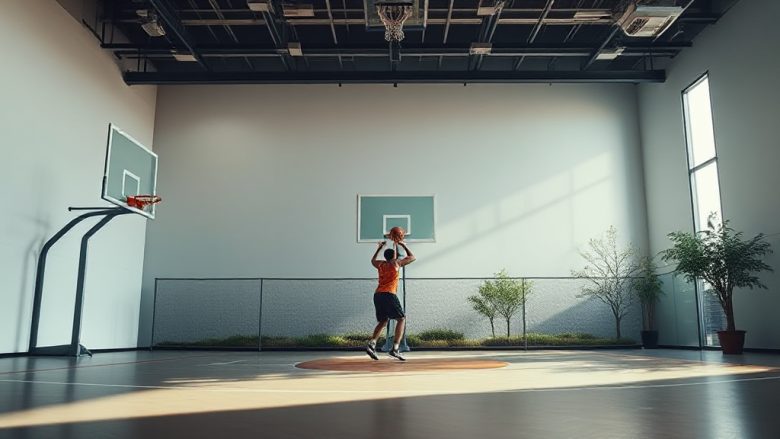
Picture a 1990s half-court. The paint is a crowded elevator: two big men leaning on each other, forearms locked, guards cutting through a space already full of legs. There’s nowhere to drive, so you post up and hope. Now pan to today. The same paint is almost empty, the center is standing out beyond the three-point arc, and the driving lanes look like cleared hallways.
That shift is the whole story. More spacing pulled centers away from the rim, so their value moved from pure post scoring and paint protection toward shooting, passing, screening and covering ground on defense. The big man didn’t get worse. The job changed.
So how exactly did spacing change the center position in basketball, and why did it happen? To see it clearly, start where centers used to live: under the rim, in traffic, with barely room to breathe.
The Crowded Paint Era: When Centers Lived Under the Rim
Why the Old Rules Kept Two Bigs Near the Basket
Before the floor opened up, the rules themselves made crowding the paint the smart play. Under the old illegal defense guidelines, defenders had to commit to a man or double hard, and zones were effectively outlawed. You couldn’t just park a helper in the lane and wait. So teams did the next best thing: they kept two large bodies close to the rim at all times, one to guard the post and one to shadow the other big.
Hand-checking culture did the rest. Guards could be bumped, steered and slowed on the perimeter, which made it hard to turn the corner and get into the lane cleanly. If driving was a grind, why spread the floor? Coaches reasoned that bodies near the basket created more problems than space ever could.
The Classic Center Job Description
The center’s role was narrow and clearly defined. Score on the block with a hook, a drop step or a turnaround. Crash the offensive glass for second chances. Protect the rim on defense. That was the job, and it was enough.
Nobody asked the big man to shoot from eighteen feet, let alone beyond the arc. A center who could pass out of a double team was a bonus, not a requirement. The position rewarded size, strength and footwork in a phone booth, and little else.
How Crowded Paint Strangled Guards and Entry Passes
With two bigs and their defenders packed into the lane, driving lanes vanished. A guard who beat his man met a wall of shoulders and elbows. Kick-out passes had nowhere clean to go, because the perimeter was often left to shooters who were an afterthought.
Entry passes were a grind too. Feeding the post meant threading the ball through traffic while a defender fronted or a second man dug down. Every possession felt like moving furniture through a narrow hallway.
The Trade-Off: Dominant Inside Play Versus Floor Balance
The payoff was real. A dominant big could control the glass, score efficiently near the rim and erase mistakes on defense. Teams built around that advantage and won with it.
But the cost was floor balance. Spacing was poor by design, transition lanes were clogged, and half-court offense often bogged down into a slow, physical wrestling match. The game rewarded patience and brute force over movement and shooting.
Why a Slow, Physical Center Still Had Huge Value
In that environment, footspeed mattered far less than mass and position. A center who could hold the block, seal his man and finish through contact was a genuine asset, even if he’d be a liability in open space.
This is the baseline to keep in mind. The crowded paint didn’t punish slow bigs; it protected them. Once spacing arrived, that protection disappeared, and the position had to change. That shift is exactly how spacing changed the center position in basketball, and it starts with the floor opening up.
How Spacing Changed the Center Position in Basketball
The shift didn’t happen overnight, and no single rule did it alone. Three forces pushed in the same direction at roughly the same time: a surge in three-point volume, rule changes that freed up movement, and an analytics movement that convinced coaches to chase efficient shots. Together they stretched the half-court wide, and the center was standing in the middle of the change.
The Spacing Revolution: Threes, Rules and Analytics
Teams started taking far more threes because the math was too good to ignore. A corner three was worth more per attempt than a long two, and front offices noticed. At the same time, rule changes cracked down on hand-checking and physical contact on the perimeter, which made it easier for guards to turn the corner and harder for help defenders to grab and hold. Analytics then pushed coaches toward layups and open threes, the two most efficient shots on the floor. Every extra shooter on the court meant one fewer body near the rim, and the paint slowly emptied out.
Why a Packed Paint Became a Liability
In the old game, a help defender could sag off a center who couldn’t shoot and still recover in time. That was smart defense. Once teams surrounded their bigs with shooters, that same sag became a death sentence: the center’s defender parked in the lane left a shooter wide open on the wing. Coaches learned to punish it. A center who couldn’t shoot or pass from the perimeter started to feel like a spare part on offense, and defenses stopped respecting him.
The Center’s Dilemma: Clog the Lane or Leave the Paint
That created a genuine bind. Stay near the rim and you clog the driving lanes your guards need. Step out to the arc and you pull yourself away from the offensive glass and the post-ups that used to define your value. Modern centers usually split the difference, hovering around the dunker spot or the top of the key depending on the possession. The ones who could shoot from deep forced their defender to follow them, which is exactly what opened the floor for everyone else.
Pick-and-Roll and Pick-and-Pop Pull Bigs Away From the Basket
The pick-and-roll became the engine of modern offense, and the screen itself dragged centers away from the block. A big who set a high screen had to decide whether to roll hard to the rim or pop out behind the arc. Both choices moved him off the low post. Pick-and-pop bigs turned the center into a perimeter threat, and defenses had to account for a seven-footer spotting up, which pulled a second defender away from the paint on nearly every possession.
The Defensive Cost: Guarding in Space and Protecting the Rim
The other end got harder too. With the floor spread, centers now have to hedge a ball screen, recover to their man, and still protect the rim on the same possession. Switching onto a guard in space used to be a mismatch to exploit; now it’s a routine part of the job, and slow-footed bigs get hunted until they’re off the floor. The center’s defensive value shifted from standing near the basket to covering ground, communicating, and surviving in space without giving up the rim.
The New Center Skill Set: What Modern Bigs Have to Do
Once the floor stretched out, the center’s job description had to be rewritten. A big man who could only score over his right shoulder and block shots near the rim suddenly looked slow and one-dimensional. Spacing didn’t just move centers around the court; it forced them to add skills that were optional a generation ago. Here’s what a modern big actually has to bring.
Shooting, or at Least a Credible Catch-and-Shoot Threat
If a center can’t shoot from outside, his defender sags into the paint and clogs the very lanes spacing is meant to open. That’s why even a modest jumper matters. A big who hits the occasional pick-and-pop three or mid-range shot forces his man to step out, and that one extra step of respect is often enough to free a driving lane. He doesn’t need to be a volume shooter. He needs to be a threat the defense can’t ignore.
Short-Roll Passing and Decision-Making
When the ball handler comes off a screen and gets trapped, the center often catches the ball in the pocket — that short roll in the middle of the floor. From there he’s a playmaker, not a finisher. He has to read whether to hit the rolling big, find a corner shooter, or attack the recovering defender himself. Hesitate, and the advantage disappears. Quick, simple decisions are the whole skill.
Screening Angles and Timing
Screening used to be a chore. Now it’s a core offensive weapon. The angle of the screen decides which way the ball handler can turn the corner, and the timing decides whether the defense gets caught flat-footed. A well-set screen creates the space; a sloppy one wastes the possession. Good bigs treat screening like a craft, constantly adjusting their feet and body position to open a gap.
Defensive Mobility: Drop, Switch and Closeouts
Spacing pulled centers out to the perimeter on defense too, and that exposed slow feet. Modern bigs have to drop back in pick-and-roll coverage without getting torched, switch onto smaller guards when needed, and close out on shooters without fouling. The center who can only guard the paint is a liability the moment the offense drags him away from it.
Strip it down, and a spacing-friendly center separates himself from a paint-bound one by mastering a handful of competencies:
- A catch-and-shoot jumper that pulls his defender away from the rim.
- Short-roll passing and fast decisions when the pick-and-roll gets trapped.
- Precise screening angles and timing as a real offensive skill.
- Defensive mobility across drop coverage, switches and perimeter closeouts.
- The stamina and footwork to do all of it while covering far more ground.
None of these skills replace size. They sit on top of it. A center still has to rebound and protect the rim. But spacing made the old baseline — post scoring and paint protection — the starting point rather than the whole job.
Before and After: Comparing Center Value Then and Now
The quickest way to see how spacing changed the center position in basketball is to line up the two versions side by side. The table below compares the paint-bound center of the 1990s with the spacing-era big man of today.
| Area | Paint-bound center | Spacing-era center |
|---|---|---|
| Scoring | Back-to-the-basket post moves, close-range finishes, free throws earned by drawing contact | Rolls to the rim, lobs, put-backs, and enough jump shooting to punish a sagging defense |
| Passing | Simple kick-outs when doubled; the post was often a finishing station | Handoffs, short-roll reads, and cross-court passes from the elbow or top of the key |
| Defense | Camped near the rim, protecting the paint, blocking shots | Dropping, switching, and sprinting out to shooters; covering ground matters as much as height |
| Value | Measured in points, rebounds and blocks near the basket | Measured in floor gravity, screening, spacing and defensive range |
Why Some Old-School Centers Still Thrive
A bruising post scorer isn’t obsolete. Against small lineups he can punish switches and force double-teams, and a drop-coverage team with strong perimeter defenders can hide his lack of shooting. Fit decides more than era.
The Trade-Off Teams Still Face
Choosing a shooting center usually means giving up some rim protection and rebounding muscle. Choosing a traditional anchor often means a clogged paint. Most teams split the difference with two bigs who cover each other’s weaknesses.
Common Mistakes When Judging Centers
Assuming every center must shoot is wrong; plenty of effective bigs survive on screening and finishing. Ignoring rebounding and interior defense entirely is just as costly, because spaced-out offenses create long misses and second-chance points.
What to Watch When Judging Fit
Check whether he can defend in space, whether he sets real screens, and whether defenders respect him beyond the arc. Those three answers tell you more about his value in a spread offense than his post moves ever will.
Why the Modern Center Is More Than a Post Player
Return to that same half-court now. The paint is empty, the lane looks like a cleared hallway, and the center is loitering beyond the three-point arc, waiting for a kick-out or setting a screen at the top of the key. The bodies that once clogged the middle have been pulled outward, and the position has been redefined by that pull.
That’s the whole cause-and-effect chain in miniature: spacing dragged centers away from the basket, so their value migrated from post scoring and paint protection toward shooting, passing, screening and covering ground on defense. And it keeps adapting. As offenses stretch further and bigs handle the ball more, the center who can’t stretch the floor or move laterally will keep losing minutes to one who can. The position isn’t dying. It’s just being asked to do more, further from the rim.